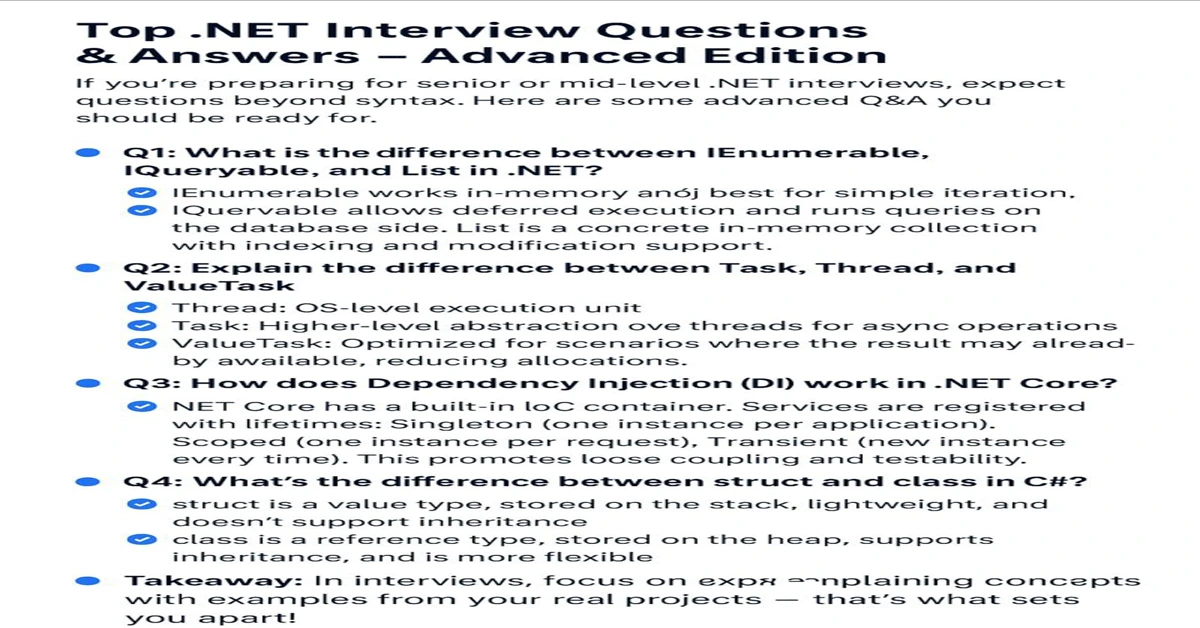
Top .NET Interview Questions & Answers – Advanced Edition
- If you’re preparing for senior or mid-level .NET interviews, expect questions beyond syntax. Here are some advanced Q&A you should be ready for:
Questions & Answers
- Que1: What is the difference between IEnumerable, IQueryable, and List in .NET?
- Ans: IEnumerable works in-memory and is best for simple iteration.
- Ans: IQueryable allows deferred execution and runs queries on the database side.
- Ans: List is a concrete in-memory collection with indexing and modification support.
- Que2: Explain the difference between Task, Thread, and ValueTask.
- Ans: Thread: OS-level execution unit.
- Ans: Task: Higher-level abstraction over threads for async operations.
- Ans: ValueTask: Optimized for scenarios where the result may already be available, reducing allocations.
- Que3: How does Dependency Injection (DI) work in .NET Core?
- Ans: .NET Core has a built-in IoC container. Services are registered with lifetimes:
- Ans: Singleton (one instance per application), Scoped (one instance per request)
- Ans: Transient (new instance every time)
- Ans: This promotes loose coupling and testability.
- Que4: What’s the difference between struct and class in C#?
- Ans: struct is a value type, stored on the stack, lightweight, and doesn’t support inheritance.
- Ans: class is a reference type, stored on the heap, supports inheritance, and is more flexible.
- Que5: How do you improve performance in an ASP.NET Core application?
- Ans: Use caching (in-memory, distributed, response caching)
- Ans: Use async/await properly
- Ans: Optimize EF Core queries (projection, AsNoTracking())
- Ans: Profile & monitor with Application Insights
- Que6: What is IEnumerable vs IQueryable?
- Ans: IEnumerable executes data in memory, while IQueryable translates queries into SQL and runs them at the database level. Use IQueryable for large datasets.
- Que7: What is Dependency Injection in .NET?
- Ans: A design pattern where dependencies are injected instead of created inside a class, improving testability and loose coupling. Built-in in ASP.NET Core.
- Que8: What is async / await?
- Ans: It allows writing non-blocking asynchronous code while keeping it readable and sequential.
- Que9: Difference between Task and Thread?
- Ans: A Thread is OS-level, while a Task is higher-level and managed by the .NET thread pool, making it more efficient.
- Que10: What is Middleware in ASP.NET Core?
- Ans: Middleware handles HTTP requests and responses in a pipeline (e.g., Authentication, Logging, Exception Handling).
- Que11: What is EF Core?
- Ans: An ORM that allows developers to work with databases using C# objects and LINQ instead of SQL.
- Que12: What are Service Lifetimes?
- Ans: Transient: New instance every time
- Ans: Scoped: One instance per request
- Ans: Singleton: One instance for the entire app
- Que13: What is Garbage Collection?
- Ans: Automatic memory management that removes unused objects to free memory.
- Que14: What is REST?
- Ans: A stateless architectural style using HTTP methods like GET, POST, PUT, and DELETE.
- Que15: What is SOLID?
- Ans: Five design principles that help build maintainable and scalable applications.