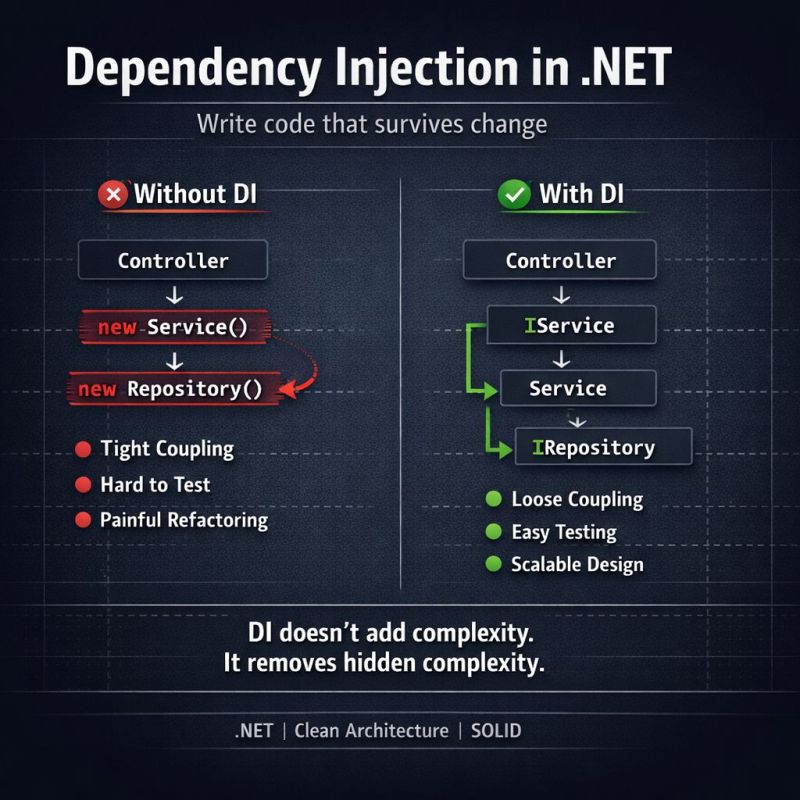
Dependency Injection (DI) in .NET
- If your .NET application works only when everything stays exactly the same, it’s not really stable — it’s fragile.
- Most of us have seen this: touch one line of code… and something completely unrelated breaks.
- That’s where Dependency Injection (DI) actually helps.
- DI isn’t about frameworks or containers. It’s about a simple habit:
- classes shouldn’t create their own dependencies — they should receive them.
Why this matters in real projects
- Loose coupling Your business logic doesn’t care how something is done — only what is done.
- Easier testing Mocks become natural. Unit tests stop being painful.
- Safer changes You can improve or replace one part without fear of breaking everything else.
- Scales better over time As the codebase grows, things stay understandable instead of messy.
- Cleaner architecture Controllers stay light. Services stay focused.
- Responsibilities are clear.
Without DI:
- Too many new keywords
- Code tightly glued together
- Refactoring feels risky
- “Don’t touch this” files
With DI:
- Swap implementations confidently
- Follow SOLID without forcing it
- Code that’s easier to live with long-term
DI doesn’t make code complicated.
- It actually makes complexity visible and manageable.
- In modern .NET, DI isn’t optional anymore.
- If your classes are creating everything themselves, it’s probably time to step back and rethink the design.