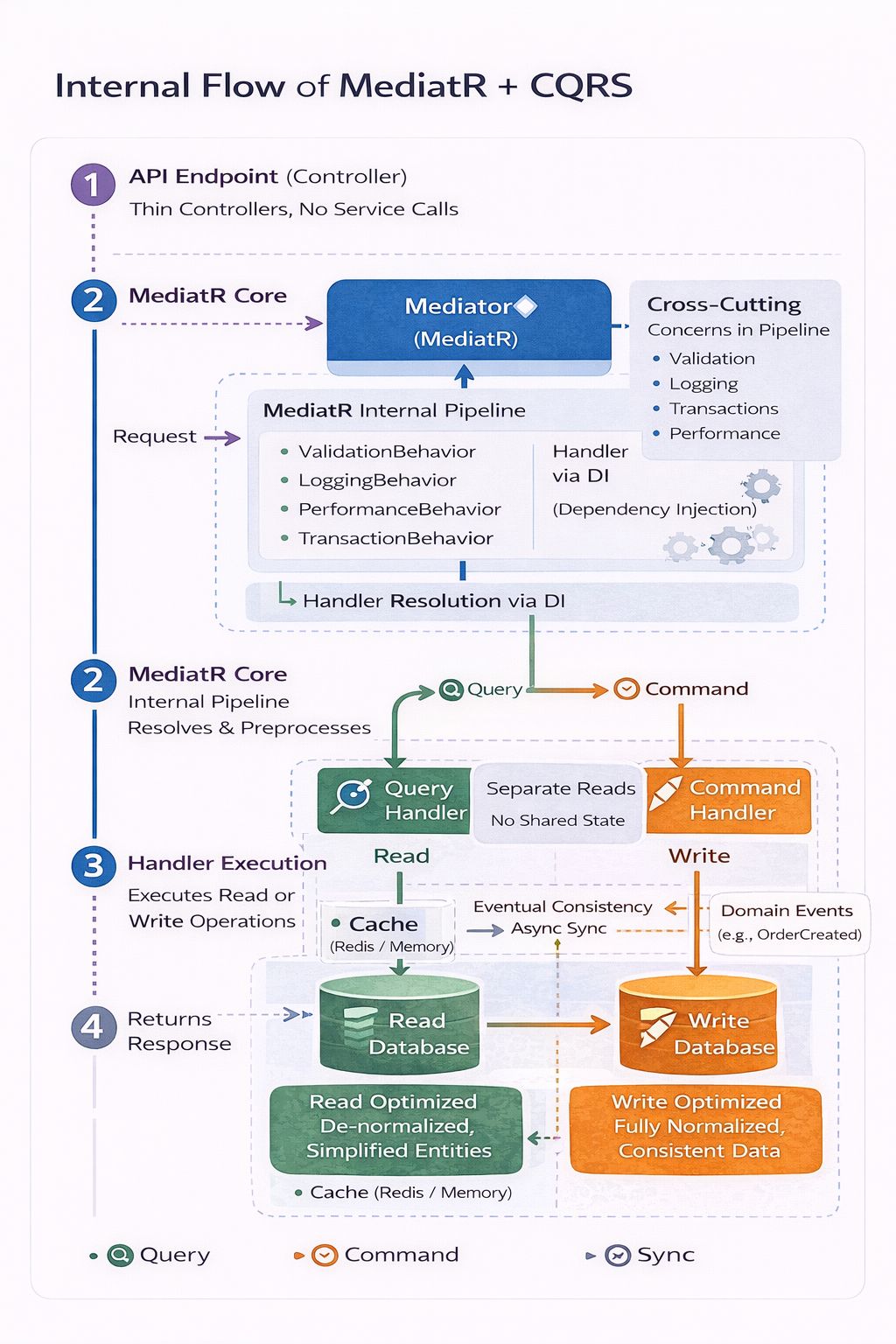
MediatR & CQRS in .NET
- As .NET systems grow, most complexity doesn’t come from features. It comes from 𝐛𝐥𝐮𝐫𝐫𝐞𝐝 responsibilities.
- That’s why I use MediatR + CQRS — not as patterns, but as 𝐠𝐮𝐚𝐫𝐝𝐫𝐚𝐢𝐥𝐬.
What this approach enforces:
- Controllers express intent only
- MediatR owns request flow and cross-cutting concerns
- Queries read, Commands write — never both
- Each request maps to exactly one handler
- Read and write models evolve independently
- The result is code that’s easier to reason about, test, and change under pressure.
Where CQRS actually helps:
- Complex domains
- Read-heavy workloads
- Performance-sensitive systems
- Clear separation between consistency and speed
Where not to use CQRS:
- Simple CRUD applications
- Small teams unfamiliar with the pattern
- Systems where eventual consistency adds risk, not value
- CQRS doesn’t remove complexity; It 𝐨𝐫𝐠𝐚𝐧𝐢𝐳𝐞𝐬 𝐢𝐭 — when the problem is big enough to deserve it.