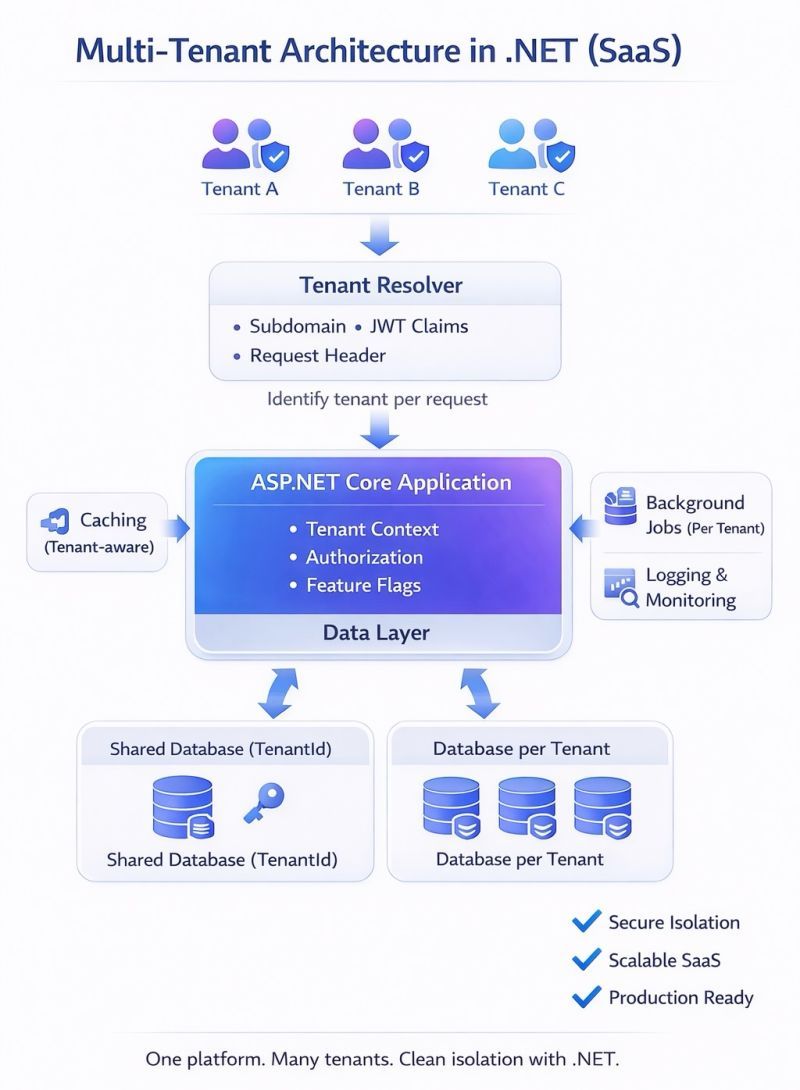
Multi-Tenant Architecture in .NET
- Most SaaS products serve many customers from a single system.
- Multi-tenancy is how you build one .NET application that feels:
- Isolated
- Secure
- Customizable
- for every tenant
Each tenant should feel like they’re the only customer.
- What Multi-Tenancy Really Means
- One application
- Many tenants
- Shared infrastructure
- Strict data isolation
Multi-tenancy is not just about saving cost — it’s about safe, scalable growth.
- Tenant Resolution Strategies (How You Identify a Tenant)
- Subdomain-based
- tenant1.app.com (most common in SaaS)
- Header-based
- X-Tenant-ID (APIs & internal services)
- Token-based
- Tenant embedded in JWT claims
- URL-based
- /tenant1/dashboard (simple, but less clean)
- Once resolved, the tenant is stored in a Tenant Context for the request lifecycle.
- Shared database + TenantId
- Real SaaS Patterns Used in Production
- Most common, cost-effective, scalable
- Per-tenant configuration & feature flags
- Custom behavior without branching code
- Role-based access within tenant boundaries
- Fine-grained security
- Soft limits per tenant
- Users, storage, API calls
- Background jobs executed per tenant
- Isolation in async processing
- Tenant-aware caching & logging
- No data mixing, easier debugging
These patterns scale without duplicating applications.
- Non-Negotiables (Never Compromise)
- Zero cross-tenant data leaks
- Authorization always enforces tenant scope
- Secure tenant onboarding, suspension, and deletion
- One tenant leak can destroy trust permanently.
Final Thought
- Multi-tenancy is a system design discipline, not a database trick.
- Design it deliberately — and your SaaS scales cleanly, securely, and confidently.